-
For nearly two decades, the travel booking ecosystem looked predictable. ✈️
Travelers searched on Google.
They clicked on an OTA like Expedia, Booking, or TripAdvisor.
They compared options.
Then they booked. 🔎This model built some of the largest travel companies in the world. 🌍
But that model is starting to crack.
Recent market signals suggest investors believe something big is shifting. 📉
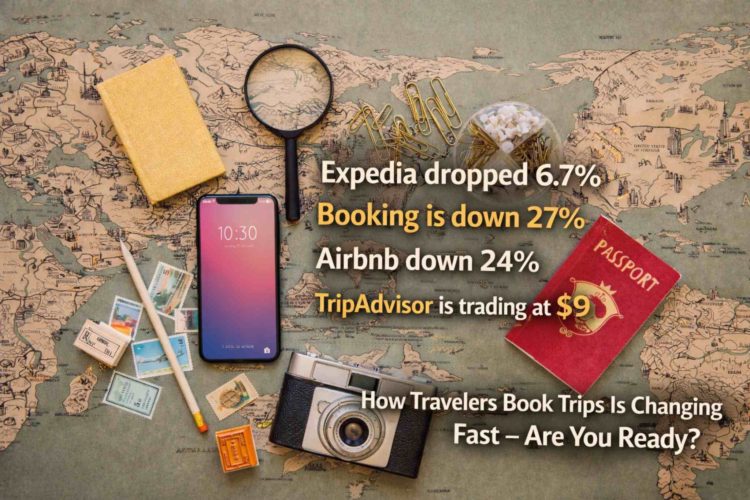
Expedia’s stock dropped 6.7%.
Booking Holdings has fallen 27% from recent highs.
Airbnb is down 24%.
TripAdvisor is trading around $9, a shadow of its former valuation.These companies are not collapsing because their businesses suddenly became weak. 💼
They are under pressure because investors see a structural shift coming to travel distribution.
And that shift has a name. 🤖
Agentic AI.
The End of the Traditional Travel Booking Journey 🚀
To understand the change, we need to look at how travel booking traditionally worked.
For the last 20 years, the process looked something like this: 🧭
- Travelers searched Google for flights, hotels, or tours.
- Search results directed them to OTAs (Online Travel Agencies). 🔗
- Travelers browsed listings and reviews.
- They compared prices and availability. 💲
- They completed the booking on the OTA website.
This process created massive platforms that controlled travel distribution. 🌐
Companies like Expedia, Booking.com, and TripAdvisor became gatekeepers of travel discovery.
They owned the traffic. 🚦
They owned the customer relationship.
They owned the booking. 🏨
But that model depends on one critical assumption:
Travelers must visit websites to book travel. 💻
And that assumption is no longer true.
AI Is Becoming the New Travel Interface 🤖
A major shift is underway in how people interact with technology.
Instead of navigating menus and websites, people increasingly prefer conversation-based interfaces. 💬
Voice assistants, AI chatbots, and intelligent agents are changing how users search for information and complete tasks.
Travel booking is one of the industries most affected by this shift. ✈️
AI assistants are beginning to:
- Search travel options 🔍
- Compare prices
- Read reviews ⭐
- Recommend itineraries
- Complete bookings 📅
- Handle payments
All inside a single conversation. 🗨️
This removes the need for travelers to visit multiple websites.
AI Agents Can Already Book Travel 🧠
This change is not theoretical.
It is already happening. ⚡
AI systems are rapidly gaining the ability to complete real-world tasks on behalf of users.
For example, advanced AI agents can: 🤖
- Browse travel inventory
- Evaluate options 📊
- Contact booking systems
- Negotiate pricing 💬
- Complete reservations
All without the traveler touching a booking website. 🙌
In some experimental systems, AI agents can even manage entire travel itineraries – flights, hotels, transportation, and experiences – through a conversational interface.
Instead of opening multiple tabs and comparing listings, travelers simply say something like: 🧳
“Plan me a 5-day trip to Bali next month with a beachfront hotel under $300 per night.”
The AI handles the rest. 🌴
When AI Handles the Booking, The Brand Disappears 👻
This creates a fascinating shift in the travel ecosystem.
When an AI assistant completes a booking on behalf of a user, the traveler often never sees the underlying booking platform. 🕶️
For example:
A traveler asks their phone assistant to book a hotel. 📱
The assistant checks available inventory.
It finds a room through an OTA API. 🔌
The booking gets completed.
But the traveler believes their assistant made the booking. 🤯
The OTA brand becomes invisible.
The website becomes infrastructure. 🏗️
The user interface is no longer Expedia, Booking, or TripAdvisor.
The interface is the AI assistant. 🤖
This changes the entire structure of travel distribution.
The Rise of “Invisible Travel Platforms” 🌐
In the AI-driven travel ecosystem, traditional booking platforms may still exist.
But their role changes dramatically. 🔄
Instead of being consumer-facing brands, they become infrastructure layers that power AI bookings.
In other words: 🛠️
They become plumbing.
The traveler interacts with the AI. 💬
The AI interacts with the booking platform.
The platform processes the transaction. ⚙️
But the brand disappears from the user experience.
This is one of the biggest reasons investors are nervous. 📉
If the interface moves from websites to AI assistants, brand power shifts away from OTAs.
TripAdvisor’s Strategic Pivot 🧭
TripAdvisor appears to understand this shift better than most.
Instead of fighting AI, the company has started licensing its review data to AI platforms. 📚
At first glance, this seems like a smart move.
TripAdvisor built one of the largest travel review databases in the world. 🌍
If AI systems need travel knowledge, that data becomes valuable.
But there is a paradox. ⚠️
By feeding its review data to AI systems, TripAdvisor is helping build the very systems that eliminate the need to visit TripAdvisor.
If an AI assistant already understands what reviewers said about a hotel, the traveler has no reason to click through to read those reviews manually. 🏨
The AI summarizes them instantly.
This creates a future where reviews exist everywhere but review platforms disappear. 👀
Why Investors Are Concerned 📊
Investors are forward-looking.
They do not just analyze current performance. 🔍
They try to anticipate future disruptions.
And the rise of AI-driven booking suggests that the travel industry may be approaching a major structural change. 🌪️
If AI assistants control the booking interface, the question becomes:
Who controls the AI? 🤔
Because whoever controls the AI controls the distribution.
The Regulatory Gap Nobody Is Talking About ⚖️
Another critical factor in this shift is regulation.
The European Union has forced Google to treat travel companies more fairly in search results. 🇪🇺
This helped reduce the power imbalance between Google and travel platforms.
But AI assistants operate in a different regulatory environment. 🧠
Right now, there are very few rules governing how AI travel recommendations work.
That means AI platforms could theoretically: 🚨
- Prioritize certain hotels
- Recommend preferred airlines ✈️
- Highlight specific tour operators
- Route bookings through exclusive partners 🤝
Imagine if an AI company made an exclusive deal with a hotel chain.
Every user who asks the AI for hotel recommendations might see that chain first. 🏩
This kind of influence could reshape travel distribution overnight.
The Shift From Search Engines to AI Agents 🔄
For decades, travel companies optimized for Google search.
SEO became a critical growth strategy. 📈
Companies invested heavily in ranking for travel keywords.
But if travelers begin planning trips through AI assistants instead of search engines, the discovery process changes. 🤖
Instead of ranking in search results, travel companies must ensure their information is accessible to AI systems.
This includes: 📂
- Inventory data
- Pricing information 💵
- Availability
- Reviews ⭐
- Unique differentiators
If AI cannot access this information, the company becomes invisible. 👻
The New Visibility Problem 👁️
In the AI-driven travel ecosystem, visibility will depend on something entirely different.
Instead of optimizing for search engines, travel companies must optimize for AI agents. 🤖
This means making sure AI systems can understand and access key information.
Travel companies need to ensure: ✅
Their inventory is machine-readable.
Their availability updates in real time. ⏱️
Their content is structured in a way AI can interpret.
Their differentiators are clear. 🌟
If these signals are missing, AI assistants may simply skip them.
And recommend another option instead. 🔁
What Travelers Actually Want 🧳
The rise of AI-driven booking is not just about technology.
It is about changing traveler expectations. 💡
Modern travelers want experiences that are:
Simple
Personalized
Fast
Seamless ✨They no longer want to navigate complex booking funnels.
They want an experience that feels effortless. 😊
Instead of filling out multiple forms and comparing dozens of options, they want an intelligent system that understands their preferences.
AI can deliver exactly that. 🎯
The Era of Agentic Travel 🌍
A major development in this space is the emergence of agentic AI.
Agentic AI refers to systems that can perform multi-step tasks autonomously. 🤖
Instead of simply answering questions, these systems can:
Research options
Evaluate alternatives
Take action
Complete transactions ⚙️In travel, this means AI agents can potentially manage the entire booking journey.
From inspiration to itinerary. 🗺️
From reservation to payment.
From check-in to travel updates. 📲
All inside one intelligent assistant.
Industry Signals Are Already Appearing 📡
Several major companies are already experimenting with this concept.
New collaborations between travel technology providers and fintech companies aim to create end-to-end AI travel experiences. 🤝
These platforms envision a future where travelers interact with a conversational assistant that:
Understands preferences
Suggests destinations
Builds itineraries
Handles bookings
Processes payments 💳All in a single seamless interaction.
This is fundamentally different from the fragmented booking process travelers deal with today. 🔄
What This Means for Travel Operators 🏨
For hotels, tour operators, and travel brands, this shift changes the rules of discovery.
Success will depend on how easily AI systems can access and interpret their offerings. 📘
Operators must ensure:
Their inventory is integrated with booking APIs.
Their pricing and availability update dynamically. ⚡
Their experiences are clearly differentiated.
Their data can be understood by intelligent systems. 🧠
Those who adapt early may gain an advantage.
As traditional OTAs lose control of the booking interface, new distribution opportunities may emerge. 🚪
The Opportunity Hidden Inside the Disruption 🌟
While AI may disrupt existing travel platforms, it could also empower smaller travel businesses.
For years, large OTAs dominated discovery because they controlled traffic. 🌐
But AI agents do not necessarily favor the biggest platform.
They favor the best data and best experiences. 🏆
If a small tour operator provides unique experiences and makes their inventory accessible to AI systems, those experiences could surface directly in AI recommendations.
This could level the playing field. ⚖️
Preparing for the AI Travel Economy 🛠️
The travel industry is entering a new phase of digital transformation.
To stay visible in the AI-driven travel ecosystem, companies should begin preparing now. 🚀
Key areas include:
Structured travel data
API accessibility
Real-time inventory updates
AI-readable content
Clear value propositions 📌The goal is to ensure AI systems can easily understand what makes a travel experience unique.
Because in the future, the AI assistant may be the one recommending it. 🤖
The Future of Travel Booking 🔮
The shift toward AI-driven travel planning is still in its early stages.
Traditional booking platforms will not disappear overnight. ⏳
But the direction is becoming clear.
Travel discovery is moving away from websites and toward intelligent assistants. 🧠
The companies that adapt to this change will capture the next generation of travel bookings.
Those that ignore it risk becoming invisible in the new travel ecosystem. 👀
A Question for the Travel Industry ❓
The transformation of travel booking is already underway.
AI assistants are beginning to influence how travelers discover destinations, compare options, and complete bookings. ✈️
This raises an important question for travel businesses:
Are you prepared for a world where AI – not websites – controls travel discovery? 🤔
Because the next era of travel booking will not just be digital.
It will be intelligent, conversational, and agent-driven. 🚀
Expedia Down, Booking Slumps, Airbnb Drops – AI Is Changing How Travelers Book Trips
Recent Posts